His Share
Chicago · 1985
Chicago, 1985
Six weeks. Kristen’s father hasn’t come home. Or called.
That’s a new thing. He’d vanish for a month easy, that was just John, but he called. From a bar, from somebody’s kitchen at two in the morning, drunk and saying he loves her. I’ll be home by Thursday. Six weeks now and the phone on the wall just hangs there, being a phone.
The last hundred dollars is down to four ones and some change in the cigar box. Kristen counts it every night, and every night it comes out the same: not enough, and less than the night before.
She runs the options in a column, because a column is the only place she can think straight. The welfare check is Rachel’s, Rachel’s name, Rachel’s signature, and the county lady takes no other. Rachel, her mom, is four days into the flat gray nothing that comes when the good stuff runs out, down on the couch with her face to the cushions, a shape that takes water when it is brought and not much else. Rent is eleven days late. The Jewel takes cash. The landlord takes cash or a face, and she is running low on both.
That leaves John. John is money the same as weather is what it is. It comes or it doesn’t, and you can’t send it a letter. But John knows people, and John’s people carry cash in their socks and have jobs nobody writes down. One of them, somewhere in this city, knows where he is.
The rule is you do not go looking in John’s end of the world. She’d written that one herself, years ago, in her own hand. She goes looking anyway. That is the whole distance between eleven days late and out on the street, and she’s done that math too.
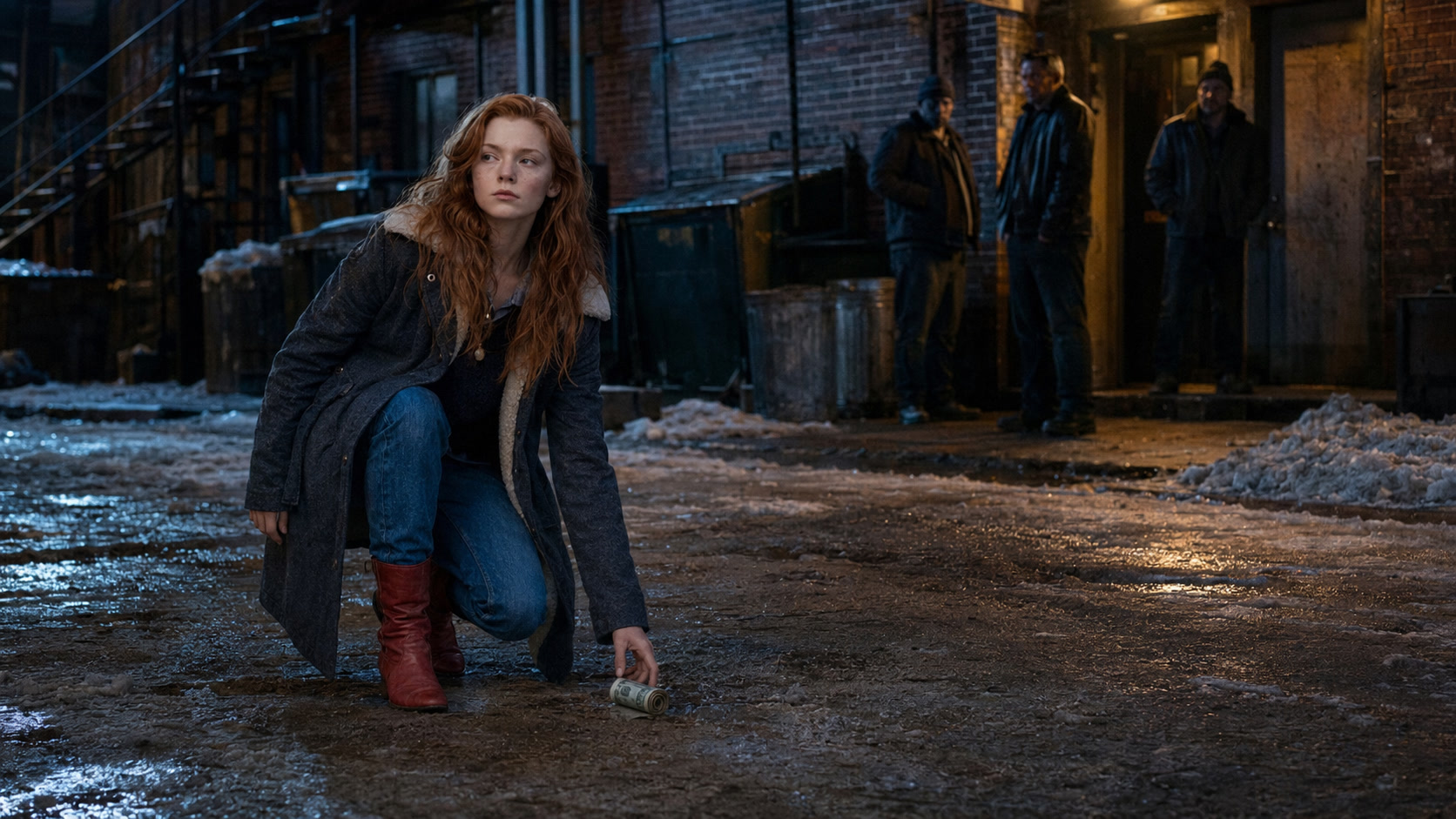
Kristen finds two of them outside the Alibi Room on a Tuesday night, in the cold, under a sign with the neon dead in it.
She knows them by shape if not by name. The tall one, soft-spoken, never in a hurry about anything. And Vince, gold eyetooth, who’d been looking at her a certain way out of car windows and across fence lines since she was fourteen, and had always made sure she caught him at it.
“Well, look at this.” Vince shows her the tooth. “Little Thornton. All grown up.”
“I’m looking for my dad. John. You run with him.”
“Ain’t seen John in a while.” The tall one. Easy, in no hurry, not looking at her.
And Vince looks at the tall one. Half a second, then he has his face back. Half a second is plenty. She’s been reading half seconds off men her whole life.
“Okay. Thanks anyway.”
She walks to the corner. She does not walk home. She comes back down the dark side of the street, to the mouth of the gangway that runs along the Alibi Room to the lots in back, where the two of them have stepped out of the wind. She puts her spine to the cold brick and listens.
Out of their sight she’s already stopped existing, that is the one dependable thing about men like these. In the mouth of the gangway they talk low and easy, two men who quit checking the street a long time ago.
A match strikes. Cigarette smoke drifts back to her on the cold wind.
“Forty grand in a wall safe. Off a lawyer’s place up on the lake, clean in, clean out. And the count comes back thirty-one.”
“Huh.”
“Nine light, Vince. Off a job I set up myself.”
“John.” Vince, flat, bored. “Whose hand else is ever in it.”
“So we take a little drive out to the water. And he’s talkin’ the whole way, y’ know how he talks, it’s a misunderstandin’, he’ll square it, he’s got a guy owes him, on and on…”
“He always figures he could talk his way out of anything.”
“Maybe with the chicks that hang out in dive bars..” They laugh. “So tell me everything. How did you do it?”
“We drove right up to the river, and he started getting real nervous. ‘what’s going on? Why are we here? I swear I’ll make it right’ like a little bitch. Then I clocked him smack in the face with my pistol to shut him up. Threw him out the car, emptied my chambers and we drove off. Bye Bye Birdie!”
More laughter.
Kristen lights up like July 4th fireworks. No thought, just action. She is around the corner and into the gangway with her nails down the tall one’s face before either of them hears her coming.
“The hell…”
Skin gives under her fingers, and she is glad of it, she wants all of it.
“You fuckin’ motherfuckers, I kill you pieces of shit” comes out as shrill screams the sound of a wounded animal.
“Grab her. grab her…”
“I got her, I got…”
“Get your hands off me! I’ll scream for help,” which is exactly what she does till her lungs hurt.
One hand grabs her hair, the other covers her mouth. Two on one, her arms held tight behind her back, still trying to scream, and kick her way out of their flesh prison.
“Christ. Little wildcat opened my face.”
“Hold still, kid. Hold still, ‘fore somethin’ gets broke that don’t grow back.”
Now with her cheek pressed against the wet pavement and 450 pounds of man constraining her, there is nothing left to do but submit.
Behind her the tall one touches his own cheek, and looks at the four red lines that come away on his fingers. Not angry. Filing it.
“Y’ done?”
“No. Yes. Maybe.”
“Are y’ done fighting?”
“That’s kind’a obvious.”
“Give me his share.”
Somebody laughs.
“You want me to stop? You want me quiet. Give me his share. Motherfuckers.”
Quiet. Then the tall one thinks about it, actually thinks about it, weighing whether it is worth the trouble. His hand goes into his right coat pocket, and the fist in her hair lets go. When she gets herself off the pavement and turns there is a roll of bills in his hand. He looks at her a long moment. Then he tosses it underhand into the slush at her boots, the way you’d lob a dog a bone.
“John’s share. Every nickel he had comin’ after the nine grand he skimmed.” He is already turning to go. “Here’s some free advice on top of the blood money. You were never here. You don’t know these faces. You don’t come back to this street or this bar or this end of town, not ever, not for nothing. The man I answer to don’t pay a share twice, and he don’t care for loose ends the size of a mouthy kid. We straight?”
“What do you mean?”
“You just got one pass…you earned it. But if we ever see you again you’re gonna’ meet your papa. Kapish.”
She gets down on both knees in the slush and picks it up.
She counts it under the light at a bus shelter two blocks over, fast, hands flat on her knee. Eleven hundred and forty dollars.
She does not cry. There’ll be a time for that; this is not it. Her father is dead, she makes herself think the words, in that order, so they will hold. Her mother is a shape on the couch. There is nobody over her now, nobody under her and nobody coming. The money against her leg is the whole of what is left of John Thornton, paid out in an alley by the men who emptied him into a river.
So she runs the column one more time.
“Eleven hundred and forty dollars. I can’t stay here. I don’t want to be a nursemaid. I don’t want to end up in the river.”
She cannot stay. Men with a body count know her and know what she knows.
It is in a shoebox of her mother’s, on the back of a church envelope, in Rachel’s own hand, under a name Rachel only ever says with a drink in her: Jedediah. False Springs. The husband from before. The one Rachel ran out on.
Her mother’s whole life is a list of the men she picked, and every last one a wreck. So you bet the other way. You bet the one she didn’t pick, the one she ran from, because whatever is broken in Rachel’s picker, this is the reverse of it, and the reverse of a disaster is the only kind of safe Kristen can still afford to believe in.
Somewhere down low, in her father’s voice: that’s not the read, Slick, that’s not how you turn the card. She tells it to shut up. She is out of people. You go to the one that’s left.
The payphone outside the Rexall takes her dime on the second try.
It rings a long time. Then a click, and a weathered voice, flat and country and careful.
“Yuh. Thornton.”
“…Uncle Jed? It’s Kristen.”
The line goes quiet. Not a cold quiet. She can hear him working it. The name, the arithmetic behind the name.
“Rachel’s girl.” A breath. “John’s girl.”
“Yah.”
“…Where’s your mother at.”
“Home. She’s not good. I can’t stay here, I got no place I can…” and her voice starts a small climb toward something, and she steps on it and flattens it back out. “I need somewhere. Just a while. I can pay my way. I got money. I got my share.”
She does not know why she says the last part. It comes up the line out of the gangway with her.
“Y’ don’t pay t’ come home.” Flat and certain, the plainest fact in the world. And then the thing she’d braced for that never comes. He does not ask. Not where’s your daddy. Not why, not how much, not whose money, not what happened to your voice. Only: “Y’ll be safe here, Kris.”
Paper rustles. He is reading something off to her, slow, pleased with himself for having it.
“Milledgeville bus leaves your end at eight forty-five, gets y’ into False Springs the mornin’ after. It’s the last stop before Milledgeville. I’ll be standin’ right there when y’ step down. Right there. Y’ hear me.”
“Yah. Okay. I’ll take the next bus. False Springs right?”
She packs in twenty minutes, in the dark, because the dark is a habit and the light wakes her mother.
She takes the suitcase. The hardshell, the good one, the single thing in the apartment that came out of the place Rachel calls Before You, with a lock that still works. She puts the money in a sock and the sock down in the toe of the case, and tells herself she’ll do the job right at the other end. She puts on the red boots, the ones she’d bought a skimmed dollar at a time, the one splendid crime of her life, and the gold locket, under her shirt, where it stays warm.
She leaves forty dollars in the button box on the shelf, folded small under the spare buttons, and she takes four of the buttons. She cannot tell you the arithmetic of either. She hangs the door key back on its nail. A key on a nail is a day’s head start; her mother will think she’s gone to school.
In the doorway of the front room she stops.
Rachel lies on the couch in the particular way that is not sleep. Too still, one arm hangs off the edge, the streetlight lies across her like something spilled. Kristen stands in the door a while. She does not turn on a lamp. She does not write anything down. There is no sentence that fits on a page; every one she starts is a lie or a leak, and she has a bus to catch.
She lets herself out and locks it behind her.
The terminal at night is mostly floor. She goes into a stall and takes the sock out of the case and moves it inside her shirt, flat against her ribs, where her father had sworn a blade would never once think to look. It is the only thing he ever taught her that she can carry out a door and use, and she uses it, and if that is grief it does not knock first.
The ten forty westbound is half empty. She takes a window. She sets the case on the aisle seat, between her and the shape of everyone else, and winds the strap once around her wrist, so that nobody takes it without taking her too. Rules. The rules are the one thing that has never left.
The bus pulls out. The city goes by in the glass. The whole cold grid of it, every lit window a room with somebody in it, and not one of them hers.
“…Please.”
To no one. To the window.
She cannot tell you what she is asking for. It is the only prayer she owns, and it has exactly one word in it, and she spends it, and then she puts her head to the cold glass and does not sleep, and Chicago lets her go without once looking up.
Reader conversation
What stayed with you?
Share a reaction, a question, or a detail you noticed. Your email is never displayed.