The 8:15
False Springs · 8:15 a.m.
The vast expanse of rural America has been running flat and empty past the window since the dark has turned to early morning light. Kristen watches it appear out of the grey morning fog lifting off the heartland. She sees no buildings, no corners, nowhere to hide. It’s flat as a tabletop with weather touching the ground. Her first real finding about her parent’s origin story, logged somewhere around six a.m. with her cheek against the cold glass.
In the city, trouble finds you. It’s come down the street and looks like everybody else. It has a block and anonymity to plan its attack. In the flatland, distance is on your side. The land itself is your surveillance. Filed away that under adjust accordingly as sleep finally comes with the strap around her wrist.
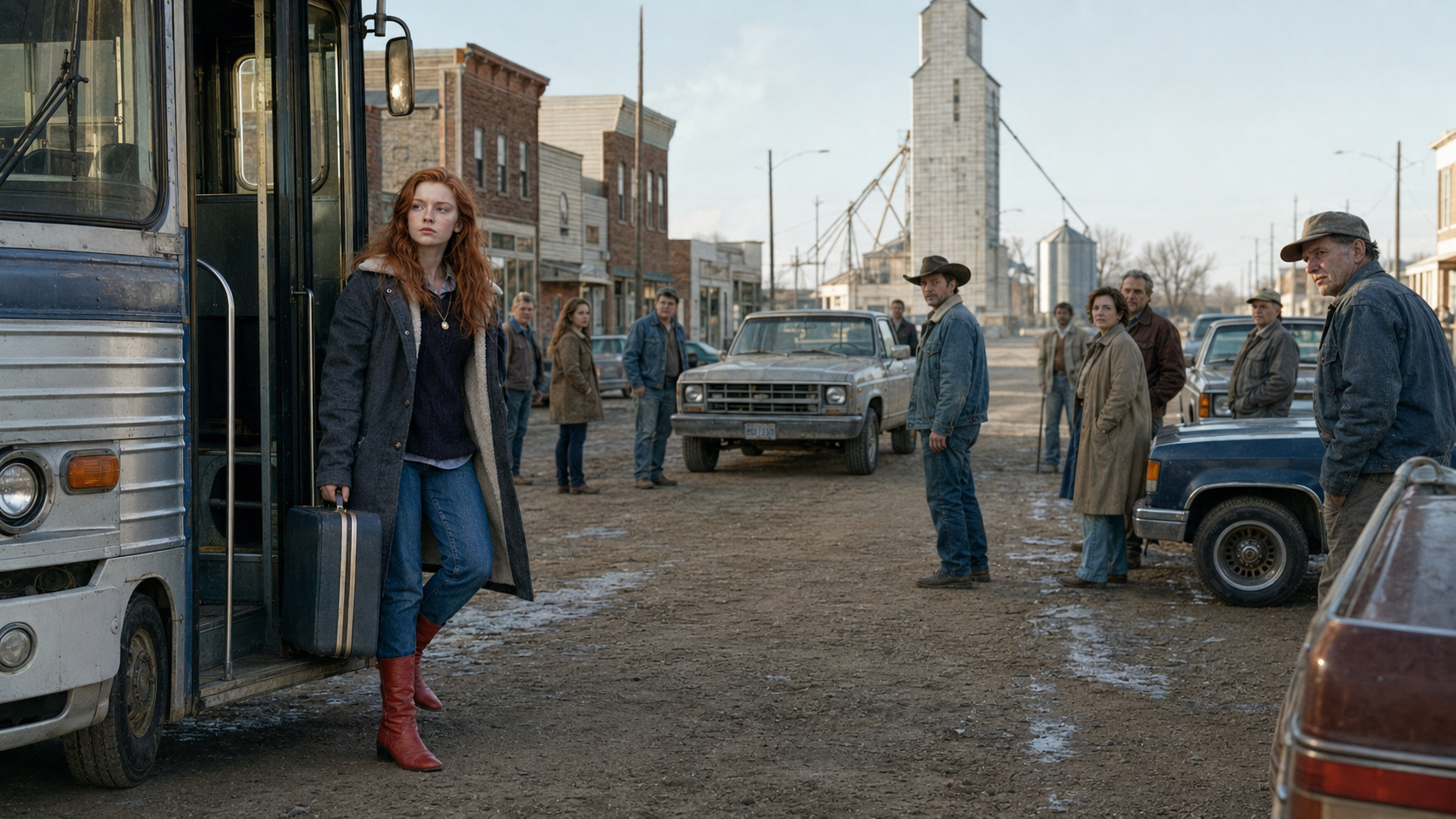
At 8:15, exactly, with a hiss, humph and heave of air brakes and flying dirt, the bus bucks to her final destination. WELCOME TO FALSE SPRINGS. FINE FOOD ’N FRIENDLY FOLKS.
Two blocks. That’s what she sees looking at it through the window while the driver works the door. The entire downtown business district is two blocks of low brick buildings, weathered boards, angle-parked pickups, old dirt road, a church steeple and farm country people going about their business. At the far end all on its own, a gigantic grain silo, tall, gray, silent.
A church for a different religion.
Kristen tilts her head, standing still, taking it all in. Sixteen hundred miles from home. Never set foot out of Chicago, but she recognizes something in it. Her mother’s voice floating in the air. Years of static finally breaking through.
“A silo like a church for a diff’rent religion, baby. It’s true. It looks exactly like that. It is the first thing anyone from that country ever told me that has checked out at one hundred cents on the dollar.”
“Maybe all those stories were true. The farm, the water under the ground, the wedding, the prizes. The people.”
Her red boots hit the dirt, clacking down the road, sending up biscuit colored dust. False Springs gets its first look at what the 8:15 has brought it.
Main Street buzzes. It turns, the way a field turns when the wind changes.
In the window of the diner across the way, BULDUC’S, the gold letters say, and under them a hand-soaped sign, GOING OUT OF BUSINESS, SEE YOU IN THE NEXT LIFE, a cup stops halfway to a mouth and comes down without arriving, a little rope of spilled coffee climbs down somebody’s newspaper. Faces assemble at the glass.
Outside the white church, a minister and a farmer quit their sentence in the middle and hold it there, two men in a photograph of themselves. An elderly couple coming out of the hardware shake their heads at one another with the settled economy of a verdict drafted years ago and only waiting on a defendant. They climb into a station wagon older than she is.
Kristen stands on the depot boards, the tinny leak of the headphones in her hand. She listens and lets them look. She knows what she looks like the way weather knows itself, without one ounce of apology. Unlike weather, she packed on purpose. The boots, the socks, the jacket, the hair: the whole rig is load-bearing.
“I did not come to this strange country without any plan; I raised my flag first and it says ‘I’m not lost, I’m not asking.’ The price of admission is more than you’ve got. The city knows it. But this little town is going to need a transfusion to figure me out.”
By the door of the package store down the street, a big man, courthouse-big, his face the weather-side of a cliff, a folding chair entirely surrendered beneath him, sits watching not her but the street watching her, which she catches at once, because it’s what she’d have done. Beside his shoulder stands a wooden Indian, chipped and ancient, one hand raised. As she watches, the big man raises one eyebrow at the statue, slow, confiding, as if to say you seein’ this? And something in her, uninvited, wants to laugh for the first time in twenty days.
Two women stand at a car half a block up: a shapely one with a hardened face and a friend built like a mailbox. They’re staring with the particular stare she’s begun to collect off the older women here in her first ninety seconds on the ground. Not the men’s stare; she has the men’s stare catalogued in nine languages; this is different, this is arithmetic. The up-and-down of a woman working a sum she doesn’t like arriving at. The wind brings her their voices in pieces.
The mailbox one folds her arms. “It’s in the Bible, y’ know. ‘Strange doin’s shall ye see in th’ final days.’”
“Little slut.” The shapely one doesn’t trouble to lower her voice.
The mailbox one’s arms come down. “Vera Stiles.”
Filed. She gives the woman one level second of the flat gray audit over the top of her Walkman, somebody who lost something once and never found out it was her own self that took it. Awards herself the point, flat, and turns her back on that side of the street. Her heart is going harder than the transaction justifies. Twenty days, no sleep to speak of, a river nobody’s heard of, and the man who is supposed to be at this depot is not at this depot.
He promised he’d be here. She stands with her suitcase, her mother’s suitcase, hardshell, home again where it was bought and neither of them knowing it. Small town. Trucks break. Farms eat mornings. The voice on the phone had a porch in it and it said yes with no beat at all. Give it the length of one cigarette before the auditor opens a file.
She’s crushing the butt under her boot when the red convertible comes out of the alley by the pizzeria backwards at the speed of bad news. It stops hard, a U-turn with frantic, tire-squalling, dust cloud devotion. She nearly awards it a point too.
“Hey, Sweet Thing.”
The passenger blurts out.
The driver elbows him, hard, out of some instinct for market conditions, then pushes his sunglasses up into his hair and produces a smile she recognizes at once from the city, though this is a corn-fed edition of it: the cocksure one, three sizes of confidence too big.
“Hey. Tim Bloch.” A beat, and then embarrassment:
“This ’s Freddy.”
Freddy leans across the seat. “Need a lift?”
“Got one, thanks.”
“Where t’?” Tim keeps his eyes on her.
“The Thornton Ranch.”
It gets away from Freddy first, a bark, and then Tim catches it too, and the effort of suppressing it does unflattering things to both their faces.
“What’s the joke, boys?”
“No ranches here, Miss.” Tim, handling it, or believing he is.
“Y’ mean Jed Thornton’s farm.”
Freddy gives the word a little English on the way out, the way you flick a card. She prices it instantly. There’s a joke under the joke, something local, something about the man, and she declines to buy at the listed rate.
“You know him?”
“Passed him up th’ road. Truck broke down.”
There it is. File closed. Trucks break. She looks away down the two blocks so the relief will have somewhere private to happen.
“C’mon. Hop in.” Tim’s already out and around to the door. “I’ll take y’ there.”
They’re out of the car in a scramble. Freddy packs her suitcase into the space behind the seats with a tenderness he has never shown such an object. Tim holds the door open. Freddy attempts to fold himself into the front seat alongside the two of them and is banished to the back seat, where he rides wedged sideways with his knees up.
“Welcome t’ False Springs, Miss…”
“Kristen.”
And the red car peels off the dirt road onto the blacktop with the whole town’s Saturday-morning eyes on it, out past the last parked trucks, out past the silo standing up alone against the sky, into the flat gold running country. About a mile out, where the road goes straight enough to see the curve of the earth, she raises her voice over the radio and the wind.
“Lemme drive.”
Tim begins slowing down and pulling to the side of the road.
“Don’t stop, just slide over my way and I’ll hop over you.”
“Y’ gotta be kiddin’!”
“I do it all the time, don’t worry.”
“This is m’ father’s baby. Cares more about this car then his own kids.”
Freddy screams happily in the back as Tim and Kristen slip and slide at 50 miles per hour.
“You two are nuts!!”
“Saw that in a movie once. Never tried it.”
Full commitment, no nerves, rules of physics upheld.
“Are all the roads out here so flat and empty? I mean everything looks flat and low. I’m not used to seeing the horizon.”
Kristen puts her foot down hard on the pedal, walking the noisy engine up through its registers, hair flying off her shoulders like a flag at war.
“This here is th’ heartland Kristen. Flat and more flat.”
Freddy sticks his head between the two in the front seat. “’Cept when the corn fills out then it’s flat and higher flat.”
Screaming down the center of the two-lane country highway, sixteen years old, joy riding at the wheel of somebody else’s convertible under the biggest sky she has ever seen.
It happens at the speed of trouble. A truck materializes out of the heat shimmer dead ahead, its horn blaring. Both vehicles suddenly occupying the same lane on an otherwise empty road.
All three at once “Oh shit!”
Tim is beside himself.
“Get out of the way! Get out of the way! Now!!”
Without losing a beat and not a second too soon, she swerves hard to the left. The world goes sideways in a long scream of rubber and smoke. Both vehicles trading ends of the road, gravel roaring in the wheel wells and flying everywhere.
As quickly as it started, the too-close call is over. The two machines sit rocking on their springs on opposite shoulders, facing each other across thirty feet of road in sunlit silence.
Kristen stares at the man directly in her line of sight in a clean, not new pickup truck. He is checking on the girl sitting in the passenger seat.
“Probably his daughter. That was too close.”
He comes out of the cab, clearly agitated, pulling off his soda-soaked shirt. He’s built like a man who has been working physically all his life, his voice carrying with a mix of anger and concern.
“Great God on the prairie! What d’ y’ think you’re doin’, Tim?”
“Hi, uh, sorry, Mr. Anderson, I uh…”
“Your father’s car. I tell him, you’ll never sit behind that wheel again!”
Kristen steps out of the car, dusting herself off, and looks across at the shirtless Bill Anderson. He looks at her.
She banks it on the spot, in her permanent files, under new species, footnote, requires study: the man feels her look. She watches it land. She has watched her look land on men since the seventh grade and knows every single thing they do next. This one does none of them.
Bill puts his shirt back on and buttons it to his neck. Kristen files the first genuinely new male behavior she has encountered in her professional auditing lifetime.
“I don’t have a drawer that fits it. Time to start a new one. False Springs farmer.”
In the cab of his blue pickup, Bill Anderson gets back in beside his daughter and pulls his door to.
“Fool kids. Must ‘a been clockin’ ninety! Who’s that?”
“Tim ’n Freddy.”
“No.”
He’s watching the girl slide back into the passenger seat of the convertible, the morning sun making a bonfire of all that hair. Something at the back of his neck has been standing at attention since the two windshields stopped thirty feet apart, some piece of him twenty years out of date insisting, against the plain arithmetic of birthdays, that he knows. “…that.”
“Nobody I know.”
“Coulda’ sworn…” He hears how it sounds, and quits.
“What?”
“Forget it.” He puts the truck in gear. His hands want the wheel at ten and two more than usual this morning. Down the road behind them the convertible pulls away, trailing radio.
Tim takes the wheel back the moment Bill takes off and guns the engine to get as far away as possible, as quickly as possible. He pulls off onto a dirt field road, gets out of the car and sits on the hood. Freddy follows while the two of them compete for her attention.
Freddy removes his letter jacket and lays it across the hood next to him.
“Hey Kristen…”
Tim fake punches him and they elbow each other.
“She’s not going to sit next t’ y’, y’ jerk.”
“Hey Kristen, yur’ seat awaits.”
Kristen observes these two boys like a scientist in a new country and decides to change the power dynamic.
“Who wants to smoke a joint with me boys?”
She mischievously takes a joint out of her purse, making a show of it.
“Someone have a light or are you just going to pray for fire?”
Tim pulls a lighter from his trouser pocket and reaches over to provide the requested spark of fire.
“All right!” Freddy breathes.
“Wo.” Tim, warning, half-thrilled, glancing up and down twelve miles of empty road for the law. “Wo!”
A truck heaves past loaded with grain sacks, the blue pickup again. Bill Anderson and his daughter, two heads swiveling in the cab toward them as Kristen takes a drag and passes the joint to Tim. “Here.”
“No thanks… in trainin’.”
Freddy accepts gladly and mimics her handling of it move for move. A large pull on the joint and a massive coughing attack, eyes watering.
“You’ve never smoked before,” she throws her head back and laughs.
Clearing his throat. “Just a couple a’ times. This shit is way stronger.”
Tim and Freddy look at her the way the whole fair once looked at a girl on a folding chair with a glass of sweet wine. Her laughter plays out over them visibly.
And something in Kristen pulls up short. “What?”
She can feel it, the thing in her hands right now, idling, all that horsepower just sitting in it, unlocked, hers, ten minutes into the country. These two would do things for her. Today. Actual things, at actual cost, on nothing more than the theater she’s run off one joint and one laugh. And behind them the town would have things it would do too. She’s seen the arithmetic stares, the machinery of a small market pricing a new commodity.
“Eleven hundred dollars and boys like this in the palm of my hands, this is the only other capital I need.”
She fidgets with her hair. Looks up at the glorious golden sky. Their faces haven’t changed at all: two open pastures, waiting on weather.
“Okay.” She hops down off the hood, closing the exchange, sixteen going on comptroller. “Take me to my uncle’s.”
At that hour, in town, Jed Thornton stands on Main Street holding a bus schedule seventeen years old, being ministered to by his cousin.
“Lookin’ for a little girl with travelin’ bags.” He’s working hard at level. The depot man has had nothing for him but a shrug and a departure board.
George Redfeather squints off down the street. “Saw a girl in Tim’s car. Wasn’t liddle, dough.”
Jed pulls the wrinkled schedule out of his shirt pocket. “Supposed t’ be on th’ eight forty-five.”
“Lemme see dat.”
George takes the document, unfolds it with two fingers, and turns it over front and back like a fish somebody’s claimed is fresh.
“Dis is hist’ry, Cuz.” He hands it back. “D’ old forty-five’s been gettin’ in eight-fifteen almos’ two years now.”
The convertible drops her at the mouth of a long-rutted driveway a little after noon. Tim and Freddy fight over who hands her the suitcase.
“Do it together boys.”
They pull off, waving with enthusiasm. Kristen scans the property, the first look at the rest of her life.
The driveway runs a quarter mile up a low grade between fence posts that stopped voting years ago, wire slack between them. At the top of the small rise a house stands up against the big sky. In the heat of the day, with the light pouring down and the country running gold in every direction, she observes the long ruts, the leaning posts and the disused sheds.
“Charming. A bit weathered. Looks like a place in a Marlboro man commercial.”
The auditor in her stands at her shoulder the whole quarter mile up those ruts with the suitcase banging her leg, entering exceptions in the register: paint gone on the south face entirely. Porch pillar cracked, flaking, load-bearing anyway. Machinery dead in the field, a battle nobody’d cleared. A barn with its shoulders down. Fields on both sides in weeds. Not resting; she’s new but she’s not blind; the Anderson dirt she rode past this morning is combed like Sunday hair, and this dirt has simply been left, years of left.
And the auditor files every exception and initials every page. She overrides the whole report, consciously, standing in the front yard in the sun.
“Kept-up isn’t the deal. Safe is. One road in. Big sky, no creeps up the stairwell.”
And the specification never said pretty; the specification said the kind who stayed; and if the place looks like a man who stopped, entirely, for years, well. So has she. They’ll start each other up. She’s very good at running a house on mist; wait till she gets hold of one with land under it, water under the land, money in the bank.
A shadow crosses behind the front parlor curtains. Yellowed gauze; the shape of a big man; there, then not.
Watching her come. Timing his exit for the porch. Shy, she files. Of course shy; seventeen years alone at the end of this driveway; a man forgets his own doorways. And the file goes in smooth as a check into an envelope, no flag on it, nothing withheld, the first misread of the acquaintance entered in her books at noon on the first day, in her own handwriting, under welcome.
The screen door opens and a big man comes out onto the creaky boards of the porch, wiping his palms on his thighs.
He is big, the way the phone voice promised, gone soft in the middle, gray coming up the sides, and he stands at the top of his steps with the morning’s clean shirt on, looks down the yard at her, and tests the word careful as plank ice:
“Kristen?”
She has stopped in the shade of the yard tree without noticing she has. Old habit, assess from cover. She slowly steps out of the shade into the full sun, and lets it have her.
“Don’t you recognize me?”
And she watches her arrival land on him. He doesn’t look at her the way the boys do, or the coats-on men, or teachers, landlords, cops. He looks at her the way you look when the doorbell rings at a house where nobody’s rung in years. His jaw comes loose. One hand finds the cracked pillar. And then, she will remember this the rest of her life, standing in the sun watching it happen, the years come off him. Visibly. In front of her.
The slump goes out of the big frame and the shoulders come up off their pegs and the gray face opens, lit, the whole man rekindling top to bottom like a house at dusk, window by window, and what walks down those porch steps toward her with its arms coming open is somehow, impossibly, a younger man than came out the screen door forty seconds ago.
Nobody, in her entire life, has ever been that glad to see her.
“Well, will y’ look at that.” Half to himself, hoarse. Then, arms wide, the porch in his voice: “…Get over here!”
“Uncle Jed!”
She drops the suitcase in the grass and runs, and his arms close around her and sweep her up off the ground. He spins and spins her, boots off the earth, the gold country wheeling past over his shoulder. She’s laughing, and hanging on around his neck for dear life. His heart under her ear is going like a big slow engine, and he smells of soap and coffee and something underneath that she doesn’t stop to parse, and the arms around her are exactly what the specification ordered, the arms of the kind who stayed.
And for the first time since the razor left the glass, standing in the middle of the turning world with her feet off the ground, Kristen Thornton stops counting.
Reader conversation
What stayed with you?
Share a reaction, a question, or a detail you noticed. Your email is never displayed.