Two Farms
False Springs · The same night
False Springs, the same night
It’s the kind of sleep that can’t come even after a tumbler or two.
Jed walks downstairs in the 4 am pitch black and flips the light switch, noticing, as if for the first time, seventeen years of his private decay. Piles. Piles and piles and piles. Papers, congregations of bottles, frayed, browned magazines, taking it all in through the eyes of another.
“What will she think of this?”
Then he enters the kitchen, more piles. Dishes, cans, some half full, more bottles and last night’s half-eaten dinner.
He turns on the tiny, old black and white television and as it talks to itself he fumbles around for the bus schedule.
“It’s gotta’ be somewhere, I just had it.”
He finds it sticking out from underneath the dinner plate, pulls it out and partially smooths the deeply crumpled paper with the heel of his hand. Until last night it lived crumpled up in the everything else drawer.
“Eight forty-five. Mornin’, it says. Milledgeville bus, False Springs stop.”
He reads the bus lines and time columns over and over. He has it by heart. In his heart.
“She called. Rachel’s girl called me. Out of all th’ people in th’ world t’ call. Only thing I owe Rachel free and clear.”
Jed’s ledger. He keeps track of what’s paid out and what’s owed, as any man should. Sitting at the round, yellow Formica kitchen table, he runs down his life ledger as if talking to the tv.
"Runnin’ red down ever’ damn page. Wife, gone. Brother, gone, with the wife. Land bank wants t’ take my land. I’m owed, owed and owed s’more. Seventeen years of the world helping itself to what’s mine. ’cept the money from the sign, that’s all mine.
And then, she called, said my name.
Can I come?
The ledger is finally being paid back. Givin’ me back what should have rightfully been mine."
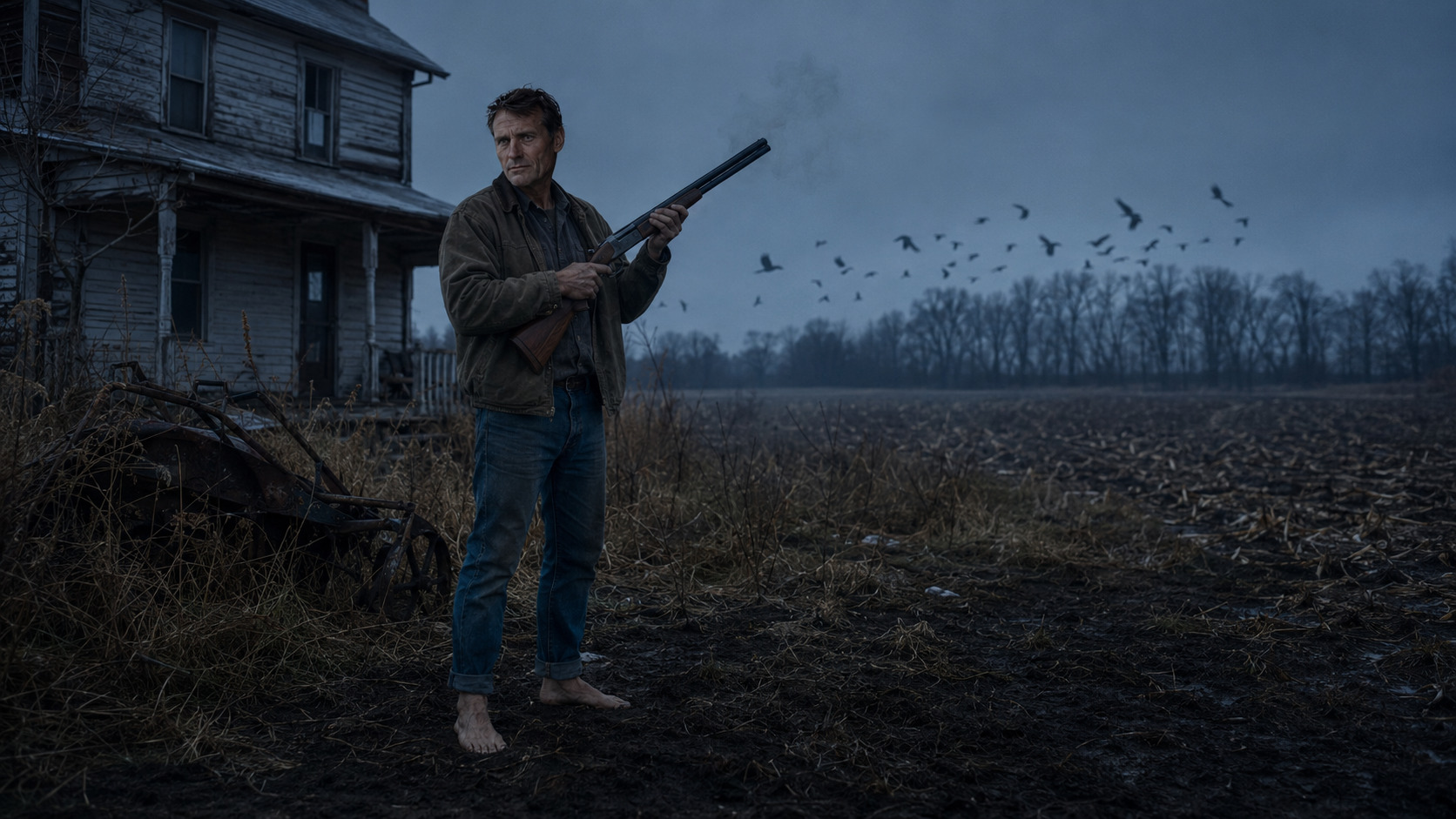
At first light he takes the shotgun off its pegs and walks out back into the cold, dewy outdoors. He walks down three creaky steps, grinds his bare feet into the moist soil and faces the expanse of his inheritance. Hundreds of acres of pristine land passed down from his father’s and his father’s before him. Staring straight ahead at his unkempt acreage, Jed puts the gun to his shoulder, sits his sight and blasts both barrels roaring into infinity.
Crows come up off the shelterbelt, cawing and insulted. The field goes on standing there. He could not tell you what the shot is for. No varmint in it, no reason a neighbor could be given, and he does not hunt reasons anyway; hunting reasons is city work. But standing there with the barrels smoking in the cold he feels something arrange itself in his chest that has not stood up straight in years. Squared up. Level. Set true, like a beam come home on its post.
The field has had it coming. Everything, this morning, is going to get what it has coming.
Inside, he pulls a mug of yesterday’s coffee out of the microwave he bought two winters back off a television offer, it’s the one purchase of the decade he is purely vain about. Carrying the mug upstairs, he stands in the door of his bedroom and looks at the task ahead.
“Little behind on m’ chores. Can’t have her seein’ m’ Rachel shrine.”
He pulls the color-bled snapshots off his mirror frame one at a time, slowly, thinking through each removal and the story behind it. The happy churchyard, first time on the freshly painted porch, the fair, down, down, down. Each ripped from it’s pin with a small tearing complaint, each dropped into his keepsake shoe box one at a time.
“Last time I look at you Rachel. Nineteen, here yer’ twenty, another maybe twenty-two. Been lookin’ at yer’ pictures longer ‘n I knew ya’.”
Then he pulls the Buick shot.
His hands know that one before his heart agrees to it. Rips it fast, hurts him less. Most of it comes away in his fingers: the fender, the good chrome, the two of them leaned into each other laughing at the man behind the camera. A ragged corner stays under the pin, up in the top of the frame. An elbow. A piece of the world. Nothing you could name unless you already knew the whole of it.
He looks at the torn piece a second. Then the box gets the rest, and he puts it in the corner of the closet with the side of his boot, easy, not unkind.
The wedding picture stays.
“Girl might like t’ see her mother’s weddin’. Ought t’ know where she come from. Family’s family.”
He stands at the bureau with his hand half-way to it, the church steps, the good suit, the girl caught mid-turn laughing her silver laugh. He withdraws his hand and sighs.
Jed leaves the picture where it is and considers his chores.
He takes the Urban Bourbon off the night table and puts a pour in the coffee, one practiced tip of the bottle, and raises the mug to the picture and says the grace of the house, the six-thousandth time, morning edition, except that this morning, for the first time in the liturgy’s whole history, there is something nearly sociable in it, something almost forgiving, the tone of a man settling an old tab on his way out of town for good.
“Fuck you, Rachel.”
“Your girl is coming in on the eight forty-five. I win.”
The billboard went up on the State Road edge of his land two summers back, and it is the only thing in the county Jed Thornton is paid money not to shoot.
Two hundred a month plus benefits. Enough cases of the product to last a year each time the truck pulls up: Urban Bourbon. Forty feet of it. A woman in a bathing suit the size of a sympathy card reclines under a palm tree with a glass in her hand, sipping, delighted with herself, and over her head in letters the height of a horse:
YOU CAN TAKE IT OUT OF THE CITY…
BUT YOU CAN’T TAKE THE CITY OUT OF…
URBAN BOURBON!
Urbane!…Refreshing!
Under her permanent tropical morning, at twenty of eight with frost still in the ditch grass, Jed’s truck coughs twice, shudders the length of its gray battleship body, and dies.
It has picked its spot. He sits a moment with his hands on the wheel in the enormous flatland quiet, the tick of the cooling engine, a meadowlark on a fence post singing its morning song, directly beneath the woman and her drink and her weather, her glossy forty-foot delight aimed out over his unplowed field at the exact angle of a laugh.
He heaves out of the cab and eyes the sign.
“What th’ hell’re you lookin’ at.”
He gets the hood up, jiggles and pulls on anything in reach.
“I swear this hunk a’ junk just needs a big kick in its ass!”
With that he gets himself in football field goal position and kicks the truck with all his might, once, twice, and three times.
“That’ll do it.”
He gets back in the truck and turns the key in the ignition. As the engine turns over and over, he pumps the gas pedal like a madman, catching a break on the fourth try. He rolls toward town under a sky coming up blue as fresh paint, the schedule folded in his shirt pocket.
“Eight forty-five, eight forty-five. Plenty a’ time.”
Over the rise, back of the Thornton place, the Anderson farm comes up out of its own dawn like something a seed company commissioned.
Dark soil, turned and raked in rows you could sight a rifle down. A barn the red of a schoolhouse crayon, painted a year before it needed it, which is the whole Anderson doctrine in one fact. Milk cows at the fence line breathing their patient steam, a fat cat crossing the yard on business, the pay-television dish on the roof aimed at outer space and beside it the old iron weathervane aimed at the actual weather, the new religion and the old one sharing a roof, neither one asked to convert.
In the kitchen, at the wooden table, Rebecca Anderson, fifteen, is conducting a negotiation of state with her mother.
“Honey, it happens t’ me least twice a year.” Her mother doesn’t turn from the stove.
“That’s you. I’m late ev’ry single month, reg’lar as church, and Coach still makes me run th’ mile with th’ boys.”
“Then y’ run it with th’ boys ‘n beat half of ’em, ’n that’s th’ end of it.”
“That is the exact opposite of th’ end of it, Mother.”
“Becky.” Her father’s voice comes in from the mudroom, the pleasure it takes in the joke already loaded in it. “You’re always late.”
Becky puts her face in her hands. There is no privacy in this house. Food, heat, order, love in industrial quantity, but no privacy whatever, filed long ago as a fair trade. What she can’t file is the rest of it: that being fifteen in this kitchen is a heifer at the fair, admired and graded and discussed at volume and never once consulted.
Her father comes in tracking exactly the amount of mud her mother will go to war over, takes the coffee waiting for him at his place because everything in this house waits at its place, and looks the two of them over.
“‘M I interruptin’ somethin’?”
“Uh-huh.”
“Mornin’, Daddy.”
“Keepin’ secrets from me, Becca?” He musses her hair with the whole of one hand, a thing she formally asked him to quit in approximately November of 1979, and which is therefore now a permanent institution of the household. “‘Member? Used t’ call ’er Little Becca. Cute as a bug in a rug.”
“Not anymore, Hon’.” Her mother, mild as milk at this moment.
“No?”
“She’s Rebecca now. We voted.”
“Nobody tol’ me there was a vote.”
“You were at th’ co-op.” Judy slides the eggs onto his plate. “Motion carried.”
The Little Becca Retirement Campaign is in its second year. Casualties have been heavy. An ally at this table is worth more than rubies, and her mother has just spent a good one on her for free.
“Mm.” Her father salts the eggs without tasting them first, a crime her mother lets pass exactly once a morning. “C’mon, Re-becca. We’re due at th’ co-op.”
“Hey! It’s Saturday!”
“Corn don’t know what day it is.”
“Corn’s not even in th’ ground.”
“Which is how come we’re due at th’ co-op.” He is already halfway to the stairs, and the keys come up out of his pocket and cross the kitchen in a flat easy arc, and the sentence that comes with them removes every grievance on the books at a single stroke.
“You’re drivin’.”
She takes the catch clean, one hand, out of the air. “All right!!”
The robin’s-egg-blue Toyota pickup goes down the driveway in a string of bucks, and settles, and bucks again at the road turn, and settles again.
“Clutch.” Her father has one arm along the sill, everything about him arranged to broadcast unconcern and nothing about him actually unconcerned. “Ease it out. It’s not a stomp, it’s a handshake. There. There, see. Feel where it grabs?”
“I feel it.”
“That’s th’ whole secret. Ever’body wants t’ know th’ secret. That’s it. Feel where it grabs, ’n meet it.”
She meets it. The bucking smooths into going, and it is coming to her quick this morning, the little conversation of foot and foot, and the flat gold country runs up onto the windshield and pours off both sides. Rebecca Anderson, fifteen, at the wheel of a truck cruising the road with her father in the seat beside her, sits up inside the best morning of the spring so far and drives.
“Not bad.” Coming from him, that’s cause for celebration.
She steals one look at him at a stop sign. He is watching the road with all three of his faces on at once. The graded-passing one; the something-else one that is pain; and under both of those the plain curious one, a man watching a stranger come up the road toward him from a long way off and not sure yet who it is. She knows all three of them and knows there’s no use asking after the last one, because what her father watches, he watches intently.
“Eyes on th’ road.” He doesn’t turn. “Hands at ten ’n two.”
“They’re at ten ’n two.”
“Yes, now they are.”
They pass the place where Anderson dirt turns into Thornton dirt. You can see it from the truck, the seam in the world where the raked rows quit and the foxtail takes over, like a photograph of two brothers who haven’t spoken in years.
“Like Cain and Abel.” Her father’s name for that seam, same as always.
Away south under the enormous sky the Urban Bourbon sign stands over the empty field, and her father looks at it, and then looks at the gray truck just now dragging itself onto the blacktop down at the head of the Thornton drive, and his jaw does the small tectonic thing it does whenever that quarter-section comes up in any form, an opinion its owner ruled inadmissible years ago and never once revisited.
“Somethin’ wrong, Daddy?”
“Nope.” He spits once out the window, economical, and faces front. “Co-op, then Ben’s for th’ seed corn. Then home. Don’t let me forget th’ oyster shell.”
“I never forget th’ oyster shell. You forget th’ oyster shell.”
“That’s why I keep y’ around.”
“I thought y’ kept me around for m’ sunny personality.”
“That too.” Comfortable, both hands loose now, letting her have the whole truck, and the blue pickup runs on into town under the wide-open morning with the county laid out flat and gold and ordinary on every side of it.
Off east, out past the grain elevator, the morning bus comes up through the shimmer with its marker lights still burning.
Reader conversation
What stayed with you?
Share a reaction, a question, or a detail you noticed. Your email is never displayed.